%202.svg)
Construction is changing. For many years, success in real estate was measured by size, speed and return on investment. Today, the conversation is broader. Cities now ask harder questions. How much carbon does a building create? How much energy will it use over time? Will it support health, comfort and resilience? And can a major development improve the urban environment rather than simply occupy it? That shift is why sustainability has become a core expectation for investors, occupiers, governments and communities alike.
The urgency is clear. According to Deloitte, the built environment accounts for 39% of gross annual carbon emissions when both operational and embodied carbon are considered. World Green Building Council also notes that buildings are responsible for 39% of global energy-related carbon emissions, including 28% from operations and 11% from materials and construction. In short, the way we build has become inseparable from the climate question.
That is where the idea of green building becomes especially relevant. A green building is not simply a project with more plants or better insulation. It is a building designed and operated to reduce environmental impact, improve efficiency and create better conditions for the people who use it. Done well, it also makes business sense. Green buildings can lower operating costs, support asset value, reduce regulatory risk and help developers future-proof their projects in a fast-changing market. The 2021 World Green Building Trends report found average operating cost savings of 10.5% in the first 12 months for new green buildings, 16.9% over five years, and roughly 9% average asset value growth reported by owners and investors.
The key principles of green building
At the beginning of any serious conversation on sustainable construction, it helps to return to the basics. The most effective green building strategies tend to follow a few core principles:
1. Energy efficiency
This is often the starting point. Better building envelopes, smarter façades, efficient HVAC (Heating, Ventilation, and Air Conditioning) systems, lighting controls and renewable energy integration all help reduce operational energy use and emissions. It is one of the most established and measurable dimensions of sustainable design.
2. Low embodied carbon and responsible materials
A building’s footprint starts long before it opens. Cement, steel, transport and construction processes all carry carbon costs. Green building therefore looks closely at material choice, recycled content, local sourcing, circularity and design strategies that reduce waste from the start.
3. Water stewardship
Water-efficient fixtures, smart metering, rainwater harvesting and leak detection all matter more in a future shaped by climate stress. Water is no longer a secondary issue. In many markets, it is becoming a strategic one.
4. Indoor environmental quality
People experience buildings from the inside. Air quality, daylight, thermal comfort, acoustics and low-toxicity materials directly affect concentration, mood and health. This is why sustainability and wellbeing now increasingly move together.
5. Resilience and climate adaptation
A building should not only be efficient in ideal conditions. It should also perform under pressure. Heatwaves, seismic risk, resource stress and extreme weather are pushing developers to design with durability and adaptability in mind.
6. Biodiversity, mobility and urban integration
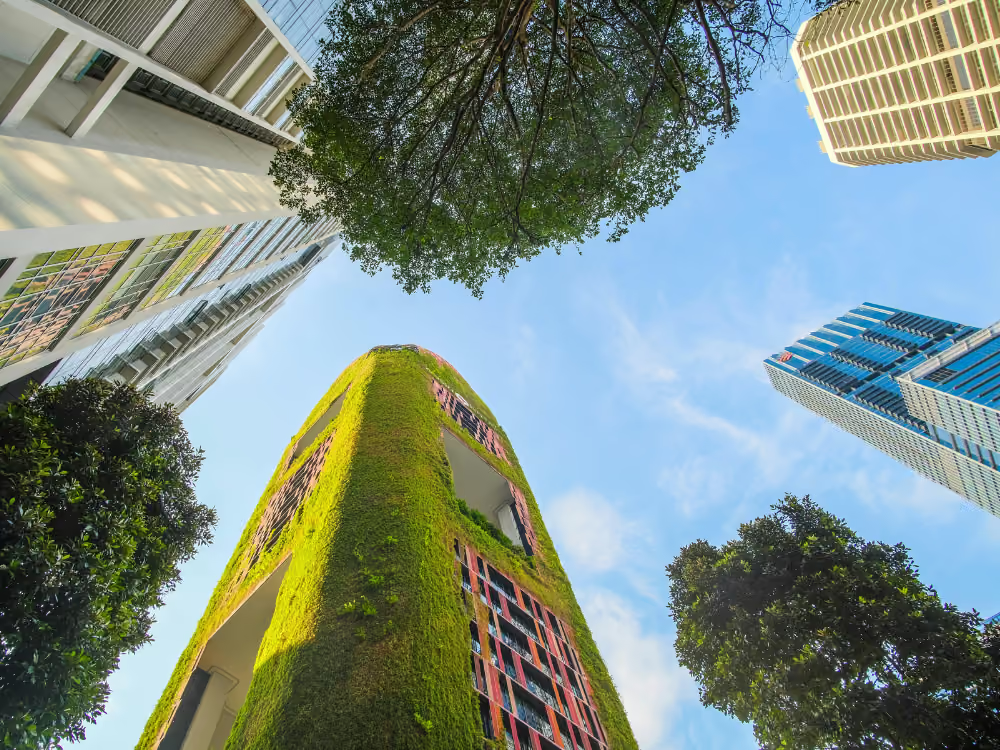
The best projects think beyond the plot line. They consider green infrastructure, shaded outdoor spaces, access to mobility, pedestrian comfort and the wider urban ecosystem. In other words, they contribute to city life instead of standing apart from it.
These principles bring clear benefits. Green buildings can reduce operating expenses, support stronger tenant demand, improve productivity, strengthen ESG performance and align better with future regulation. They also respond to a social shift. In the Dodge report, improved occupant health and wellbeing was one of the top reasons respondents said they build green.
What LEED, BREEAM and WELL actually measure
International certifications matter because they turn ambition into a measurable framework. They also help markets compare projects more objectively.
- LEED is the most widely recognized green building rating system globally. It offers a holistic framework covering energy, water, materials, waste and indoor environmental quality. In practical terms, LEED is often used to show that a project meets broad sustainability performance standards across design, construction and operation.
- BREEAM is one of the earliest and most established sustainability assessment methods. Its strength lies in lifecycle thinking, asset performance, ESG alignment, resilience, biodiversity and reporting. It is often valued by investors and project owners who want strong benchmarking and third-party assurance across the full life of an asset.
- WELL focuses more directly on people. It is an evidence-based framework intended to support human health and wellbeing through the built environment. While LEED and BREEAM look strongly at environmental performance, WELL goes deeper into how buildings affect health, comfort and experience.
Put simply, LEED asks whether a building is sustainably designed and operated, BREEAM asks how well an asset performs across its lifecycle and broader ESG context, and WELL asks whether the space actively supports human wellbeing. The most ambitious projects do not see these systems as competing labels. They treat them as complementary lenses.
What the global market is telling us
International trends show that green building is moving from leadership position to market norm. According to the 2024/2025 Global Status Report for Buildings and Construction, 20% of new commercial buildings in OECD countries achieved green certification in 2023, up from 15% in 2020. That is a meaningful shift in only three years.
The same report also shows that the sector is still under pressure. Buildings and construction were responsible for 34% of global energy demand and 34% of global energy-related CO2 emissions in 2023. Embodied carbon from materials such as steel and cement remains a major challenge. Meanwhile, only 4% of global buildings investment in 2023 was focused on green initiatives. So progress is visible, but it is not yet enough.
Looking ahead, the industry is focusing on several priorities: net-zero operational performance, embodied carbon reduction, resilient design, retrofitting existing stock, circular construction and better data. The 2021 World Green Building Trends study found that the most important approaches for the next five years include net-zero or net-positive buildings, controlling embodied carbon, resilience strategies, passive design and prefabrication. UNEP and Global ABC add that building codes, low-carbon materials, finance and retrofit scale will define the next decade.
Developing Green Taxonomy in Armenia
Armenia has recently taken a significant step toward advancing sustainable construction and green investment through the development of a national Green Taxonomy. Led by the Ministry of Economy in collaboration with the World Bank Group and the American University of Armenia, this initiative aims to establish a clear policy and legal framework for identifying and financing environmentally sustainable projects. By defining what qualifies as “green” economic activity, the taxonomy will improve access to climate finance, increase transparency, and align Armenia with international best practices seen in the EU and other markets. This development positions the country as an emerging destination for sustainable investment and supports its broader transition toward a green economy.
Why WTC Yerevan matters for Armenia
How can a global hub for trade and investment do more than perform; how can it lead?
Can a landmark development not only reduce its environmental footprint but actively restore ecosystems, improve quality of life, and set new standards for responsible growth?
WTC Yerevan’s Landmark project is set to pioneer the application of green taxonomy principles in Armenia’s construction sector, targeting net-zero readiness, Grade A standards, and internationally recognized LEED and WELL certifications.
At WTC Yerevan, these questions shape a bold vision: a future where innovation, sustainability, and human-centered design come together to create lasting impact. Here, sustainability is not a feature, it is a commitment.
WTC Yerevan is Armenia’s first net-zero-ready, Grade A mixed-use development, targeting LEED Gold and WELL certification. More than a symbol of connectivity, it is a catalyst for redefining how cities in Armenia and beyond are built and experienced.
This project brings together three priorities that rarely align: competitiveness, sustainability, and human wellbeing. The result is a model of development that is globally relevant, climate-conscious, and deeply people-centered.
Designed for resilience, WTC Yerevan responds to Armenia’s climate with smart, efficient solutions from passive shading and high-performance building systems to natural ventilation and optimized energy use. Every element is intentional. Every decision reduces impact while enhancing comfort.
Sustainability extends beyond the building. Native landscaping, water-efficient systems, and biodiversity-conscious design create a development that works with nature, not against it.
Inside, the focus shifts to people. Daylight-filled spaces, green terraces, and biophilic design support health, productivity, and wellbeing transforming the workplace into an environment that energizes and sustains.
As Armenia advances toward its goal of reducing green house gas emissions by 40% by 2030, WTC Yerevan aligns with national priorities while setting a new benchmark for responsible urban development.
This is more than a project.
It is a shift in expectations toward smarter, healthier, and more resilient cities.
And its impact may reach far beyond a single site.
.avif)

.avif)